travel-guides
What to Pack for Hajj in the Final 2 Weeks: A Practical Checklist
A practical last-minute Hajj packing guide covering documents, medication, walking gear, heat essentials, money, phone setup, and what not to overpack.
Plan your trip now
Need an eSIM for this route?
Open live Akariq plans and pick by destination, validity, and data size.
If Hajj is two weeks away, this is not the moment for a giant theoretical packing list.
What matters now is packing the items that reduce real problems: missing documents, foot pain, heat strain, medication gaps, dead phones, and communication failures during movement days.
This checklist is built for the final stretch before departure.
1. Documents: pack these first, not last
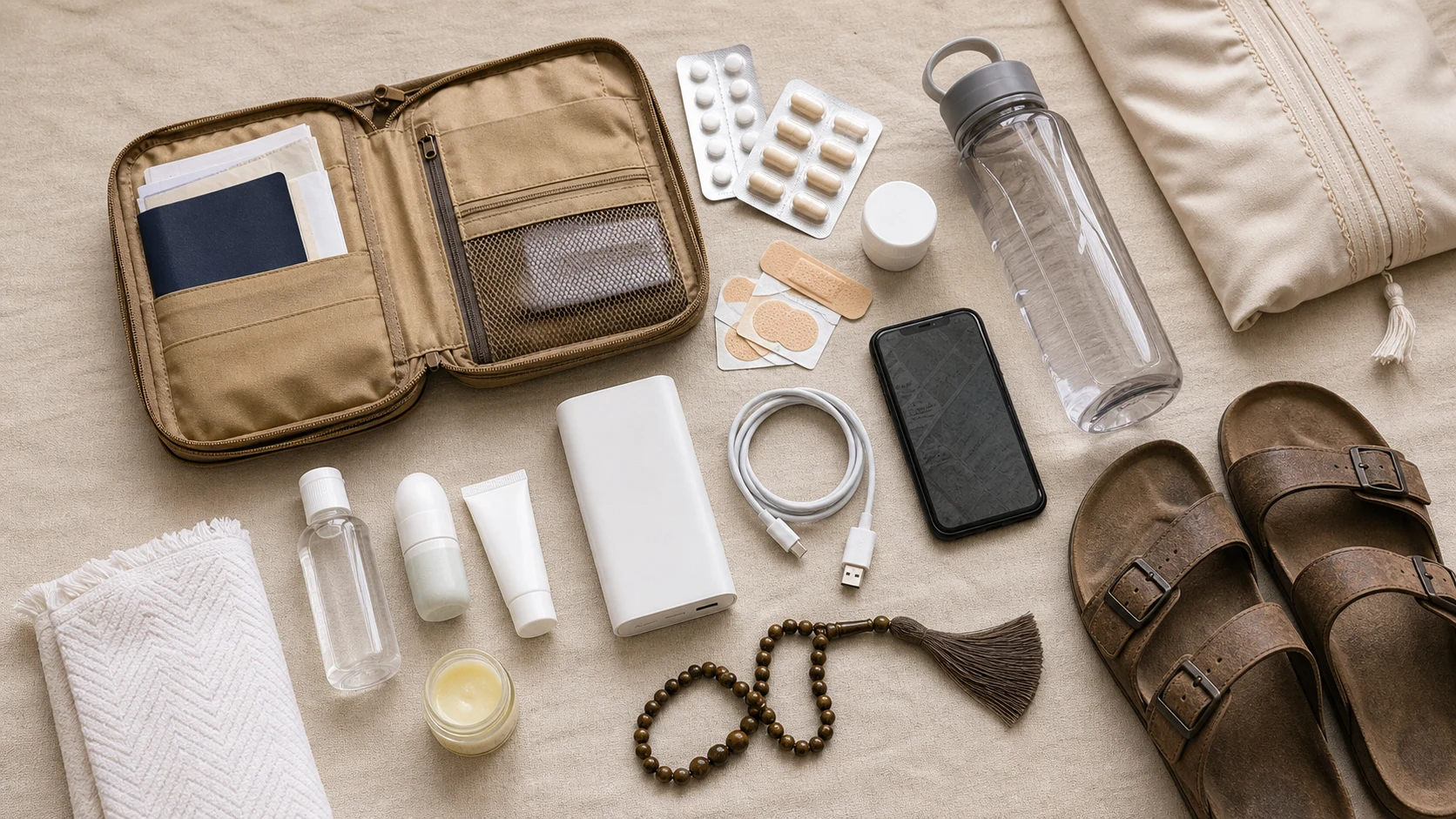
Put all essential documents in one dedicated pouch or folder.
Priority items:
- passport
- Hajj visa or package confirmation documents
- flight details
- hotel and transport confirmations
- vaccination records if required by your route or operator
- emergency contact list
- printed copies of key bookings
Do not assume your phone alone is enough. If battery, roaming, or app access fails, paper backup still matters.
2. Medication and health basics: pack for continuity, not optimism
Do not pack only for emergencies. Pack for normal daily function under heat, stress, and disrupted sleep.
Bring:
- all prescription medication in original packaging if possible
- pain relief you already know works for you
- blister treatment
- bandages or plasters
- rehydration salts or electrolytes
- any stomach medication you commonly rely on
- tissues and basic hygiene items
If you use something regularly at home, assume it becomes more important during Hajj, not less.
3. Walking gear: your feet matter more than most people realize
Hajj punishes bad footwear decisions quickly.
Pack:
- broken-in walking sandals or shoes
- one reliable backup pair
- blister pads or moleskin
- socks if your footwear setup needs them
- a small foot-care kit
Do not bring brand-new footwear because it looks cleaner or more suitable. This is one of the easiest ways to create avoidable pain early in the trip.
4. Heat management: pack like the weather is a real constraint
Even if your package is premium, you will still deal with sun, crowd density, and exposed walking.
Useful items:
- refillable water bottle if your operator allows it
- small unscented towel
- light, breathable clothing layers
- fragrance-free sunscreen if you plan to use it before ihram restrictions apply
- unscented personal care items where needed
- compact umbrella only if your operator and movement patterns make it practical
The goal is not comfort in the abstract. It is reducing heat fatigue and preserving energy.
5. Money: pack for friction, not just planned spending
Even if major costs are prepaid, you still need flexible spending capacity.
Carry:
- a practical amount of Saudi riyals
- one primary payment card
- one backup card stored separately
- small cash split across two places
This covers taxis, pharmacy stops, food gaps, and unexpected convenience purchases without turning every small issue into a bigger one.
6. Phone and connectivity: set this up before you fly
This is one of the highest-leverage parts of your Hajj preparation.
Before departure:
- confirm your phone is on the eSIM compatibility list
- install your eSIM over stable Wi-Fi
- save activation details offline
- download offline maps for Makkah and Madinah
- save hotel pins and meeting points
- create one small WhatsApp group for your immediate travel unit
- pack a charger, cable, and power bank you already trust
If you are new to travel eSIMs, read how to set up an eSIM for international travel before departure.
For Hajj, prefer STC-backed coverage where available. If you want a practical fallback, compare Saudi Arabia eSIM plans. If your route includes Gulf stopovers, Gulf regional eSIM plans are worth checking too.
7. Mina and Arafat reality: pack for limited space
This is where overpacking becomes expensive.
For Mina and Arafat, prioritize compact essentials:
- documents pouch
- phone
- power bank
- charger cable
- medication
- water basics
- light hygiene items
- foot-care items
Assume:
- space may be tight
- charging access may be limited
- Wi-Fi may be weak or useless
- bathroom access may involve waiting
Your setup should work even when conditions are less convenient than expected.
8. What not to pack too much of
Many first-time pilgrims create problems by packing for every possible scenario.
Avoid overpacking:
- too many clothing changes
- heavy bags you cannot carry comfortably
- duplicate “just in case” gadgets
- large toiletries
- unnecessary valuables
Mobility matters more than abundance.
9. Your final 48-hour Hajj checklist
Two days before departure, confirm these items deliberately:
- passport and visa documents packed
- medication packed
- footwear tested
- cash and cards separated
- eSIM installed
- offline maps downloaded
- hotel pins saved
- power bank charged
- key contacts saved outside WhatsApp
If those are done, your preparation is already better than most last-minute packing attempts.
Final thought
The best Hajj packing list is the one that reduces your dependence on luck.
You do not need to pack for every possible inconvenience. You need to cover the categories that repeatedly cause real problems: documents, medication, walking strain, heat, money, and communication.
If you want a broader preparation guide beyond packing, read Hajj travel tips for first-time pilgrims.
Ready to get connected with Akariq?
Choose your route style first: country-specific plans or multi-country regional plans.