travel-guides
Hajj Travel Tips for First-Time Pilgrims: Practical Dos and Don'ts
A first-time Hajj guide with practical travel tips on choosing providers, handling transport, preparing for walking, preparing for Mina and Arafat, and staying connected in Saudi Arabia.
Plan your trip now
Need an eSIM for this route?
Open live Akariq plans and pick by destination, validity, and data size.
If you are planning Hajj for the first time, the biggest mistake is assuming your package will remove all uncertainty.
Hajj is spiritually central, but the travel side can still be physically demanding, crowded, and operationally messy. The most useful way to prepare is not to chase a “perfect” package. It is to reduce avoidable failure points before you leave for Saudi Arabia.
This first-time Hajj guide turns common pilgrim travel lessons into a simple checklist of what to do and what not to do before you go.
Do: treat Hajj as a resilience exercise, not a luxury trip
Even expensive packages can face delays, long walking segments, crowd pressure, room changes, and transport confusion.
Go in with the right mental model:
- comfort matters, but predictability matters more
- support is helpful, but self-sufficiency is safer
- every important part of the trip needs a fallback
That mindset makes the trip easier to handle when something does not go to plan.
Don’t: book based on hotel star rating alone
Many first-time pilgrims focus on:
- five-star branding
- distance from Haram
- premium package labels
Those matter, but they are not enough.
Before booking, ask practical questions:
- Who is the actual on-ground operator?
- Who will coordinate the group during Hajj days?
- How are updates communicated in real time?
- What transport is included in practice?
- What are the Mina and Arafat arrangements exactly?
The difference between a smooth trip and a stressful one is often not the brochure. It is the quality of execution.
Do: ask how communication works during Hajj days
One of the most repeated failure points in Hajj travel is not the hotel itself. It is weak communication when conditions change.
That usually shows up as:
- delayed updates
- unclear meeting points
- changing bus times
- missing instructions during key ritual days
- confusion when groups get split
Ask specific questions before paying:
- Will there be a live WhatsApp group or broadcast channel?
- Who sends updates during Mina, Arafat, and Jamarat days?
- How quickly are schedule changes communicated?
- Who should pilgrims contact if they get separated from the group?
If a provider cannot explain its communication system clearly, assume you will need to self-manage more than expected.
Don’t: assume the Saudi provider name tells the whole story
Many pilgrims focus on the provider name, but execution often depends just as much on the local travel partner, group leader, or marketing partner handling the human coordination.
Before booking, ask:
- Who supports us before departure?
- Who meets us on arrival?
- Who stays with the group during Hajj days?
- Who is responsible for English or other language support?
The real question is not just “which provider?” It is “which team will actually guide us when something changes?”
Do: learn the rituals before you travel
Do not assume your guide will explain every step clearly when the moment comes.
Study in advance:
- main Hajj rites in order
- what is required versus recommended
- what to do if the group becomes separated
- your personal plan for Tawaf, Sa’i, Mina, Arafat, Muzdalifah, and Jamarat days
This does not mean turning the trip into a study marathon. It means removing panic when live guidance is delayed or unclear.
Useful official planning links:
Don’t: assume transport will always be smooth
One of the most common problems in Hajj travel is overestimating how seamless transfers will be.
Buses may be delayed. Pickups may shift. Shuttle access may become less convenient than expected. Roads may close. Taxis may become expensive when demand spikes.
Plan accordingly:
- budget extra cash for taxis
- save hotel names and locations offline
- confirm pickup points before leaving
- keep your subgroup aligned on one fallback meeting point
If your package transport works perfectly, good. If not, you will still be able to move and regroup.
Don’t: expect advertised package details to match reality perfectly
One recurring Hajj travel risk is service mismatch.
That can include:
- hotel quality below expectation
- meals not delivered as described
- room assignments changing
- transport access being more limited than advertised
- camp services being more basic than the sales description suggested
This is why practical questions matter more than polished descriptions.
Before booking, ask for:
- the exact hotel names
- whether accommodation is shifting or non-shifting
- expected room occupancy
- the Mina zone or camp type if known
- clear wording on meals and transport inclusions
Do: prepare for far more walking than a normal trip
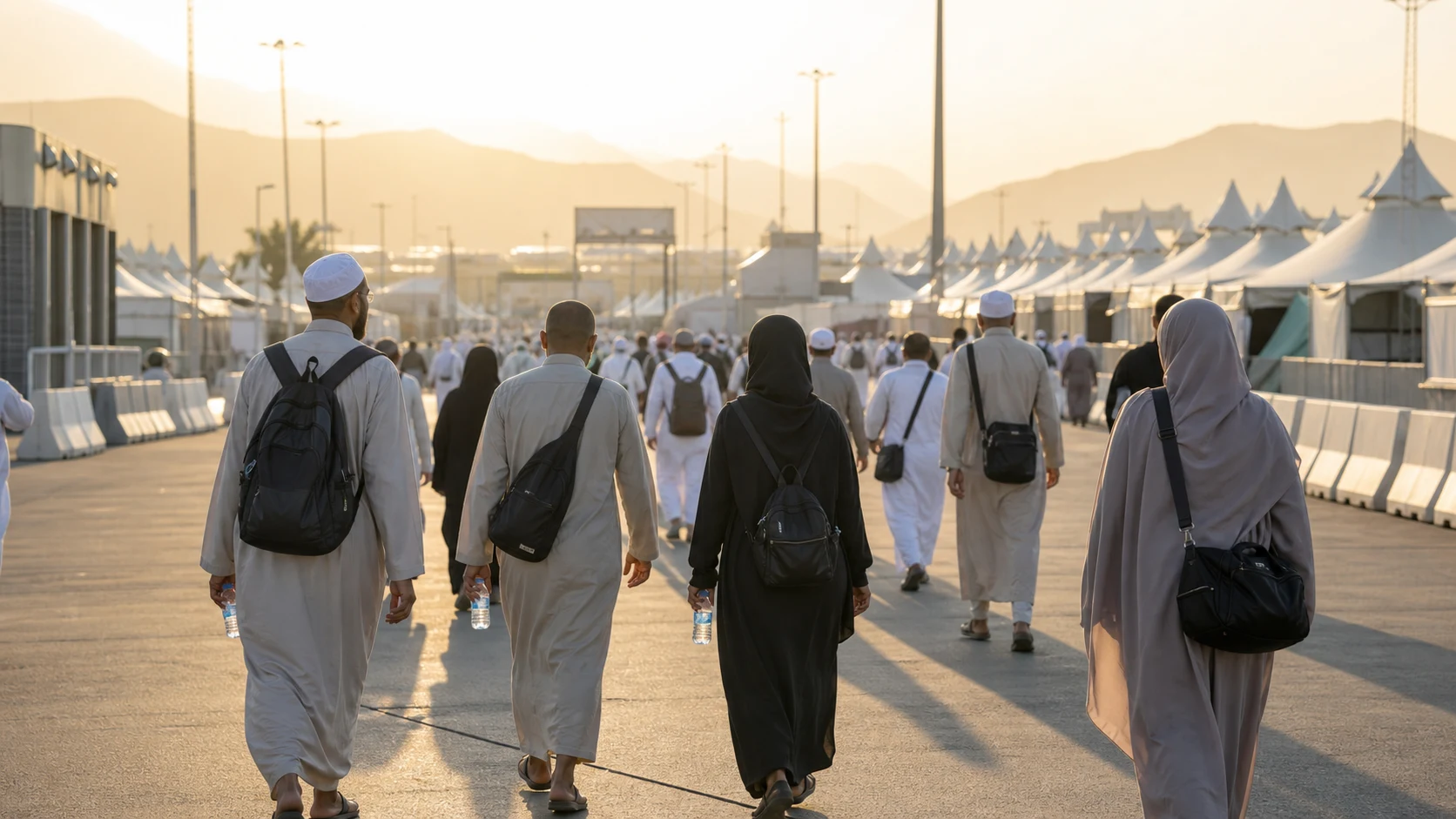
Hajj is not a “hotel to attraction” travel pattern. It includes sustained walking, waiting, heat exposure, and navigation under crowd pressure.
Prepare for:
- repeated long walking days
- carrying essentials for hours
- limited chances to stop comfortably
- extra time needed for every movement
That changes what you pack and how you plan your energy.
Bring:
- broken-in walking shoes
- blister care
- water strategy
- light carry gear
- a power bank
Do: plan for variable Mina and Arafat camp conditions
Camp conditions can vary much more than first-time pilgrims expect.
You may encounter:
- crowding
- long bathroom queues
- inconsistent cleaning
- weaker AC than expected
- limited personal space
- unreliable Wi-Fi
That does not mean your camp will be bad. It means your preparation should not depend on ideal conditions.
Pack and plan with camp reality in mind:
- keep your essentials compact
- assume charging opportunities may be limited
- do not rely on Wi-Fi for important coordination
- protect your energy for heat, waiting, and crowd pressure
Don’t: rely fully on guides to solve live problems
Some guides are excellent. Some are not. Even good guides can become hard to reach in the middle of a large movement day.
Use guides as support, not as your only system.
You should still know:
- your own ritual sequence
- your hotel name and map pin
- your fallback transport plan
- your group meeting point
- who to contact if your subgroup gets separated
Don’t: depend on camp or hotel Wi-Fi
If Wi-Fi works, treat it as a bonus. Do not build your coordination around it.
During Hajj, mobile data is often more useful than people expect. It helps with:
- WhatsApp updates from your group
- Google Maps orientation
- live location sharing
- hotel and meeting point lookup
- taxi coordination
- accessing saved notes, maps, and bookings
If you have a choice of network, prefer plans that use STC in Saudi Arabia. In practice, that is the safer default for Hajj because STC generally has the strongest combination of speed and coverage, while weaker alternatives can become more noticeable once crowds build and movement becomes more chaotic. For Hajj specifically, I would avoid plans that rely only on weaker network options if an STC-backed option is available.
If you want a simple data fallback, compare Saudi Arabia eSIM plans. If your trip includes stopovers or Gulf travel before or after Hajj, also check Gulf regional eSIM plans. Akariq regional coverage already includes STC among its partner networks, which makes it a practical fit for pilgrims who want dependable Saudi Arabia connectivity without buying a local SIM after landing.
Do: set up your phone before departure
Phone setup is easy to ignore until you need it urgently.
Before flying:
- check your device on the eSIM compatibility list
- install your eSIM over stable Wi-Fi
- save QR details and setup instructions offline
- download offline maps for Makkah and Madinah
- save hotel pins and key meeting locations
- create a small WhatsApp group for your immediate travel unit
- enable phone charging redundancy with a power bank and cable
If you are new to travel eSIMs, read how to set up an eSIM for international travel before departure.
This is one of the highest-leverage prep steps because communication problems create secondary problems very quickly.
Don’t: arrive with a vague money plan
Even if major costs are prepaid, you still need operational cash for:
- taxis
- food gaps
- pharmacy needs
- emergency convenience purchases
Do not assume card acceptance will solve every urgent moment. Keep a realistic amount of local currency available and separate from your main wallet.
Do: simplify group coordination
Large groups become chaotic fast. Smaller coordination rules work better.
Use simple routines:
- one primary group chat
- one named meeting point
- one fallback meeting point
- one person responsible for sending location pins
- one rule for what happens if someone gets separated
Complex systems usually fail under crowd pressure. Simple systems hold up better.
Don’t: overpack
The instinct to prepare for everything often creates a second problem: carrying too much.
Avoid packing as if you are moving house between sites.
Prioritize:
- documents
- medication
- hydration basics
- phone and power
- comfortable clothing strategy
- a small number of high-use essentials
The more mobile you are, the easier it is to handle delays and long walking segments.
Do: plan for strain, not just inspiration
Hajj is deeply meaningful, but meaningful does not mean easy.
The practical preparation that helps most is:
- expecting fatigue
- expecting imperfect logistics
- expecting crowd friction
- expecting some things to require patience
That expectation does not reduce the beauty of the experience. It protects you from being destabilized by normal Hajj hardship.
Quick Hajj dos and don’ts
Do:
- verify who runs the trip on the ground
- ask how communication updates are handled during Hajj days
- learn the rituals before departure
- budget for taxis and incidental costs
- prepare for serious walking
- plan for variable Mina and Arafat camp conditions
- set up mobile data before travel
- download maps and save key locations
- keep communication routines simple
Don’t:
- assume premium price guarantees smooth logistics
- assume brochure details will match real delivery exactly
- rely fully on guides for every ritual step
- expect Wi-Fi to be dependable
- travel without backup cash
- overpack
- assume every transfer will be easy
Final thought
The best Hajj travel preparation is practical, not dramatic.
You do not need to eliminate every difficulty. You need to remove the avoidable ones. If your provider performs well, that is a bonus. If not, your own preparation should still leave you informed, reachable, and able to adapt.
That is the role Akariq can play in a Hajj trip: not as the center of the journey, but as one of the tools that keeps communication and navigation working when you need them most. If you are still comparing options, this overview on how to choose the right eSIM plan for your trip can help you decide between local and regional coverage.
Ready to get connected with Akariq?
Choose your route style first: country-specific plans or multi-country regional plans.