travel-guides
Does eSIM Work in Turkey in 2026?
Travel eSIMs still work in Turkey, but you should install yours before you arrive. Here's what Turkey's eSIM restrictions actually mean for travelers.
Plan your trip now
Need an eSIM for this route?
Open live Akariq plans and pick by destination, validity, and data size.
Yes—travel eSIMs work in Turkey in 2026. The important catch is preparation: buy and install your eSIM before you arrive.
Turkey has restricted access from inside the country to a number of international eSIM providers. That has produced a lot of headlines saying that Turkey has “banned eSIMs.” That wording is too broad. The restriction is about reaching or provisioning some international eSIM services from a Turkish connection; it is not a blanket shutdown of eSIM technology or every travel eSIM plan.
For a traveler, the useful rule is simple:
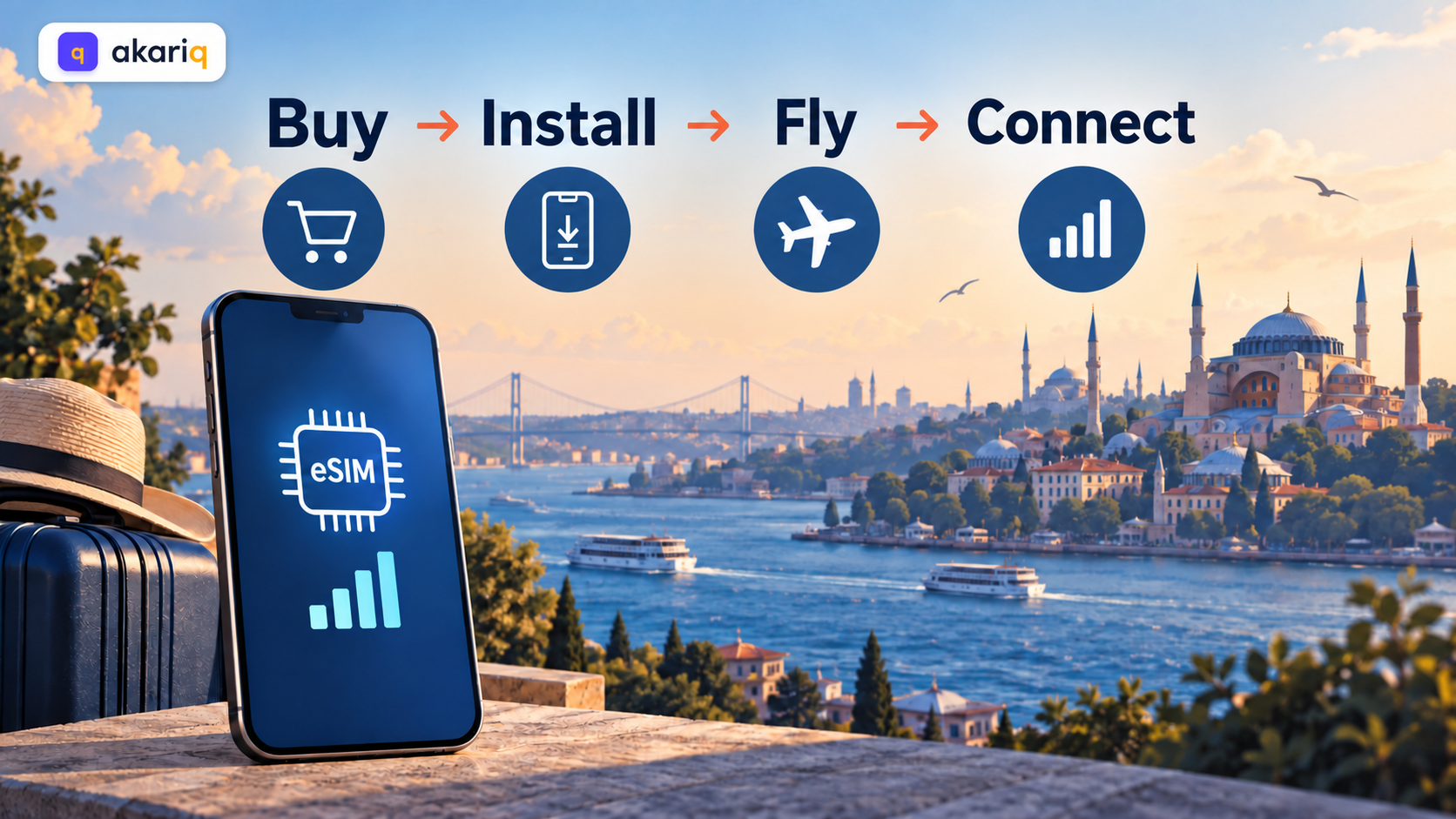
Buy → install → check the settings → fly → connect.
Last checked: September 15, 2026. Provider coverage, network access, and local restrictions can change, so check the live plan instructions before departure.
Turkey eSIM: the short answer
| Question | Answer |
|---|---|
| Do travel eSIMs work in Turkey? | Yes, when the plan supports Turkey and is installed correctly. |
| Are eSIMs banned in Turkey? | No. Some international eSIM provider websites and services have been restricted. |
| Should I install before arriving? | Yes. It is the safest option. |
| Can I buy one after landing? | Possibly, but do not rely on it. |
| Do I need a Turkish phone number? | No, if you only need mobile data. |
| Does Data Roaming need to be enabled? | Often, but only on the travel eSIM if the provider requires it. |
What did Turkey actually restrict?
In July 2025, reporting based on Information and Communication Technologies Authority (BTK) decisions said that access from Turkey to several international eSIM providers had been blocked or restricted. The providers named in that reporting included Saily, Airalo, Holafly, Nomad, Instabridge, MobiMatter, aloSIM, and BNESIM. The exact list and reachability of services can change, so do not treat an old provider list as a permanent one.
The distinction matters because using an eSIM involves several separate steps:
- Buying the plan takes place on the provider’s website or app.
- Installing downloads a mobile subscription profile to your phone.
- Connecting lets that installed profile register with a supported Turkish network.
A restriction on the first step does not automatically disable the third. Someone who installed a compatible travel eSIM before flying may be able to use data after landing, while someone trying to purchase or retrieve an installation QR code from inside Turkey may have trouble reaching the provider.
This is why “Turkey eSIM ban” is a misleading search phrase. The practical issue is access to certain services, not the disappearance of eSIM connectivity.
Does an Akariq eSIM work in Turkey?
Akariq offers Turkey eSIM plans for travelers. Before buying, check the current network, data allowance, validity period, price, and top-up details on the destination page.
Akariq travel plans are data-only. That makes them useful for Google Maps, WhatsApp messages, email, translation apps, booking confirmations, ride-hailing, and general browsing. They do not replace your existing phone number for ordinary cellular calls or SMS.
Does a Turkey eSIM work outside Istanbul?
Usually, yes in the places most visitors travel—but coverage is never identical across every road, valley, or coastline.
Istanbul, including both sides of the Bosphorus, is a dense urban area with broad mobile coverage. The main towns in Cappadocia—Göreme, Ürgüp, Avanos, and Uçhisar—are generally connected at ground level. Tourist cities and resorts along the Turkish Riviera, including Antalya, Bodrum, Fethiye, Alanya, Marmaris, and Kaş, are also well served in their built-up areas.
Coverage becomes less predictable on remote mountain roads, isolated bays, long rural drives, and near some border areas. Pamukkale and Ephesus are close to established towns, but you should still download offline maps if your itinerary includes rural western Turkey or a multi-day road trip.
The network your eSIM uses depends on the plan’s roaming agreements. Do not assume that every Turkey eSIM connects to the same carrier or offers the same performance. Check the plan page if network choice matters to your route.
What to do before flying to Turkey
1. Check your phone
Confirm that your phone supports eSIM and is carrier-unlocked. A locked phone can show an eSIM option and still refuse to install or use a plan from another provider.
If you are unsure, check the model in your phone’s settings and use the provider’s compatibility instructions before paying.
2. Buy the plan while you still have reliable internet
Purchase your Turkey eSIM before departure. This gives you time to read the plan instructions, contact support if something looks wrong, and avoid depending on airport Wi-Fi after landing.
3. Install it before arrival
Install the eSIM over stable Wi-Fi at home, in your hotel before the flight, or at another trusted connection point. Our step-by-step eSIM setup guide covers compatibility, installation timing, data settings, and troubleshooting. Do not leave the QR code in your inbox assuming you can open it after landing.
Installing ahead of time does not necessarily start the validity period immediately. Some plans start on installation; others start when the eSIM first connects to a supported network. Follow the instructions for your specific plan.
4. Save the instructions offline
Keep the QR code, activation details, APN instructions, and support information in a place you can open without mobile data. A secure screenshot or downloaded PDF is useful if your email or the provider’s website is unavailable.
5. Set the lines correctly when you arrive
The usual dual-SIM setup is:
- Home SIM: keep it available for calls and SMS, with Data Roaming off unless you intentionally want to use your home operator’s roaming.
- Travel eSIM: select it for mobile data and enable Data Roaming if the plan instructions require it.
Also disable automatic mobile-data switching if your phone offers that setting. Otherwise, the phone may fall back to your home SIM when the travel line briefly loses signal.
Why does Data Roaming need to be on?
The label is confusing because travelers often buy an eSIM to avoid expensive roaming. In this case, “Data Roaming” usually refers to the travel eSIM’s connection to a partner network—not permission for your home SIM to consume data abroad.
Enable roaming only on the line that needs it. If you are not sure which setting the plan uses, check the provider’s installation instructions before changing anything.
How much data do you need for Turkey?
Your itinerary and habits matter more than the country name. These are practical starting points for a week, not guarantees:
| Typical use | Starting point |
|---|---|
| Maps, messaging, email, occasional browsing | 3–5 GB |
| Maps plus regular social media | 5–10 GB |
| Frequent uploads, video, or video calls | 10–20 GB or more |
| Remote work or regular hotspot use | 20 GB or a plan with clear high-speed allowances |
Maps and messaging usually use far less data than video. Downloading an offline Istanbul, Cappadocia, or road-trip map can also reduce your dependence on a live connection.
Be careful with “unlimited” plans. Read the fair-use policy and check the high-speed allowance, reduced-speed behavior, hotspot rules, and validity period. A fixed 10 GB or 20 GB plan can be easier to understand than an unlimited plan with an unclear speed limit.
Can you buy a Turkey eSIM after landing?
You may be able to, but it is a poor plan for a first connection. If your chosen provider is restricted on Turkish networks, you could have difficulty purchasing a plan, retrieving its QR code, topping up, or reaching support.
Airport or hotel Wi-Fi can help you investigate alternatives, and a local Turkish SIM is another option. But these are recovery paths. If you are still outside Turkey, install the eSIM first and arrive with a working data plan.
Travel eSIM or Turkish SIM card?
For a short holiday, a travel eSIM is usually simpler: you can arrange it before departure, keep your physical SIM in the phone, and avoid searching for a shop immediately after landing.
A Turkish SIM can make sense for a longer stay or if you specifically need a Turkish telephone number. Local registration and activation requirements vary, so check the current carrier process and bring the required identification.
If you mainly need maps, messaging, translation, bookings, and internet access for one or two weeks, a data-only travel eSIM is often the lower-friction choice.
What if the eSIM does not connect?
Do not delete the eSIM as a first troubleshooting step. Some profiles cannot be downloaded again after deletion.
Try this order:
- Confirm that the travel eSIM line is enabled.
- Select it as the mobile-data line.
- Enable Data Roaming on that line if required.
- Turn Airplane Mode on for 10–15 seconds, then turn it off.
- Restart the phone once.
- Check the plan’s APN and network-selection instructions.
If the issue continues, contact the provider using the offline support details you saved. Delete the profile only when the provider specifically tells you to.
The bottom line
Turkey has not made eSIM technology unusable for travelers. The real Turkey eSIM restriction is that some international providers may be difficult to reach or manage from inside the country.
For the smoothest arrival, choose a plan that covers Turkey, buy it before departure, install it over reliable Wi-Fi, save the instructions offline, and configure the travel line for data when you land.
Sources and further reading
- Turkish Minute: Turkey blocks access to eight global eSIM providers
- TechRadar: what Turkey’s eSIM restrictions mean for travelers
- Akariq Turkey eSIM plans
This article explains a changing connectivity situation, not a guarantee of network availability. Always check the current provider instructions and your phone’s compatibility before travel.
Ready to get connected with Akariq?
Choose your route style first: country-specific plans or multi-country regional plans.